In the Deccan, pastoral communities have long relied on their deep knowledge of wool. Today, they adapt these traditional skills in creative ways to sustain their livelihoods. Join us on a brief photo journey into their craft.
About Dakhni sheep

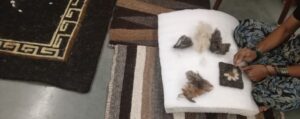
This picture shows the wool sheared from Dakhni sheep or the black sheep. This variety of sheep is native to the Deccan region, hence also called Deccani sheep. It is predominantly black in colour – the only black variety with wool in this country. The wool is coarse and traditionally considered unsuitable for fine weaving, but it is used for blankets, rugs, and local textiles. And the Kuruba community dealing with this sheep are found mainly in Maharashtra, northern Karnataka, parts of Telangana and Andhra Pradesh.
As traditional pastoral livelihoods became harder to sustain — due to shrinking demand, economic pressures and losses in income — many Kuruba families looked for alternatives. One need was to revive their traditional craft of wool crafts. And this is where the Dakhnii Diaries initiative helped- one that merged the traditional craft to mainstream markets through modern design, technology, training, and access to buyers. It is an initiative of Mitan under the leadership of Gopi Krishna and they began working with Kuruba and other wool artisans (spinners, weavers, felters, dyers) to revive the craft.
Dakhni Wool Craft

This shows a very simple yet beautiful wool craft from the Dakhnii sheep. Merging with modern designs the traditional craft of Kuruba community is getting a new life and the community – a new way of surviving along with their pastoral livelihood.
“The younger generation is coming back. We are able to make inroads and break the poverty cycle. With new designs, and training our community has got a new lease of life,” said a senior from this community.
Working with Deccani wool

The image above shows a weaving in progress. The woman working on this and whom I spoke to was from North Karnataka region. Smiling, she showed me how to work with the wool.
“The wool get sheared twice a year. We then use techniques such as felting, weaving, embroidery, and stitching to transform it into unique pieces,” she said.
Around her were various items for sale like rugs, embroideries, coasters, bookmarks etc. She also teaches these in her felting and tapestry weaving workshops.
Felting of Deccani wool

This image shows the picture of woman doing needle felting. Felting is a traditional process of binding wool fibers together. In wet felting, soap, water, and pressure are used to create a solid base. The image here shows needle felting, where a barbed needle is used to repeatedly poke the wool and handcraft the patterns.
With 35 million people in this country belonging to the pastoral community, they cannot be brushed aside as just outdated or belonging to the past. Their deep knowledge of hardy native breeds makes pastoralists a vital repository of wisdom — especially for a developing India that is prioritising animal husbandry
India has the third largest sheep population in the world. Yet all our wool requirements are met through imports. And with lack of grazing space, migration, lack of local markets, the pastoral livelihoods are under great strain.
Initiatives such as Dakhnii Diaries is one way to connect with the urban cities and showcase their heritage and also to usher in awareness of their community. So one way we the urban citizens can connect is to attend the workshops , buy their products , bring in awareness of this community by taking our kids to interact and attend their fun, interesting workshops of felting, tapestry weaving and spinning. Let us not lose our rich heritage to the changing times.
What do you say?
Note to Educators & Parents
This was an event that took place in BIC, where the event was all about India handmade collective. With traditional textiles, natural dyes and sustainability few tribal communities with their heritage were part of this. The North Karnataka Kuruba community too was part of this where they displayed their wool crafts and also did workshops on tapestry and felting. A visit to these can help children learn more about crafts, pastoral communities, and animal husbandry.
- Class 6 Students learn about sources of history, including material culture and objects. As a parent you can connect by showing how wool textiles and handmade crafts preserve cultural knowledge of pastoral communities.
- Class 7 students have a chapter on Traders, Kings and Pilgrims. So you can discuss traditional crafts, local industries, and communities. You can link shepherd communities and their wool craft as an example of living craft heritage.
- Class 12 students have a chapter on Peasants, Tribals, and Artisans under Colonial Rule.So you can focus on how local crafts, artisan communities, and animal husbandry were affected during colonial times. And link it to Dakhni sheep and wool craft as an example of traditional livelihoods, sustaining both culture and economy.
Leave a Reply