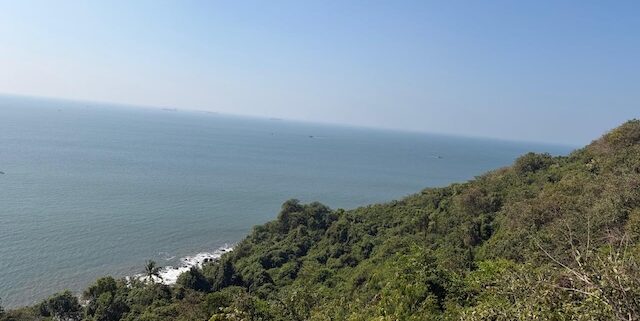
Goa’s beaches are stunning—with majestic sunrises and sunsets, blue waters, and clear skies. Some have long, sweeping coastlines, while others are strewn with rocks, making each beach distinct. If you think all beaches are the same, a visit to North and South Goa will show you otherwise.
There are beaches with red cliffs, beaches made entirely of rocks, beaches known for adventure sports, and some that boast nesting grounds for Olive Ridley turtles. Here is a brief list of Goa’s beaches, from north to south.
When you consider the Goa’s long coastline of 160 km, you find there are plenty of beaches for you to explore. Right from the north most Keri beach to the southern Gajibaga beach there is plenty to do in Goa. Each beach is unique in its own way. And let us find out a bit about them.
Goa’s North Beaches
Keri beach:
If you don’t like the crowds, start here. Located at the extreme north end of Goa, it is less commercialised. You can walk along the shore, reflect, pause with leisure. Not much crowds and not many shacks here. The Tiracol River meets the Arabian Sea here, creating a striking landscape. At the distant you can see the Tiracol fort which was once in the hands of Sawantwadi Bhonsales and was captured by Portuguese in 1746. This fort is a hotel today.
Arambol beach
South to Keri beach is Arambol. The hippie image that Goa once stood for, can be discovered here. In the 1980’s the hippies made this their home. The village name was Harmal which got corrupted to Arambol. This is where you will find many backpackers, travellers as this beach is relatively one of the affordable and most happening places- drum circles, music- in the evenings. Paragliding, a fresh water lake near Paliem beach are few other attractions of this place.
Mandrem beach
This beach is quieter than Arambol. So ideal for artists and writers if they are looking for some work to get done. You can do long beach walks, watch the glorious sunrise and sunsets, do birdwatching near the shallow lagoons. Water sports like dolphin watching, crocodile spotting can be done here.
Morjim beach
This beach is famous for being the nesting grounds of Olive Ridley Sea Turtles. These are small turtles who use this beach as a nesting ground from November to March. Their shell is olive green; hence the name.
Though in the month of December I did not find any-the locals mentioned it would be another month or so, yet a visit to this beach is a must. It has a wide, sandy shoreline with gentle curves and one of the beauty of this beach is that you get open views of the sea with fewer visual distractions. The beach is clean.
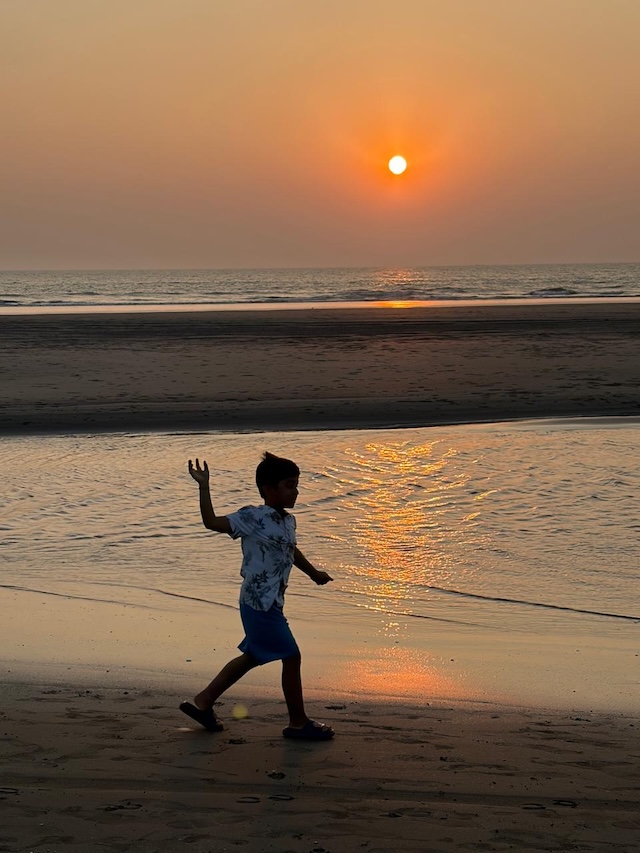
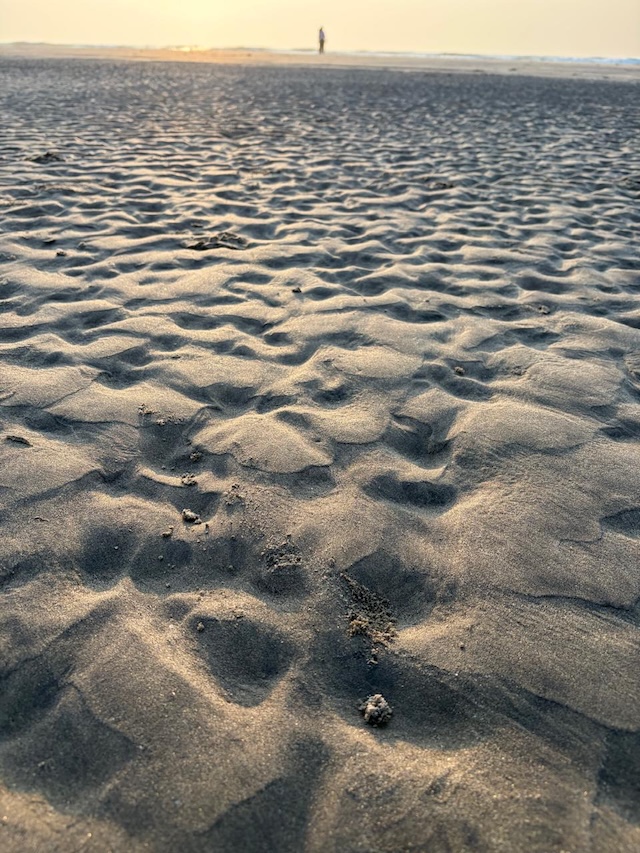
But here is another reason why you must visit this place. It has a gradual, shallow seabed.The shore doesn’t drop suddenly, waves spread out thinly instead of crashing deep.
This creates a sheet of water that moves back and forth near the coast.After the breaking of the waves near the shore, the water flows calmly over the flat sand, creating a playful shallow stretch. It becomes a paddling ground. And is an ideal place to have fun for kids. This is also why the beach is suitable for turtle nesting — gentle slopes make it easier for Olive Ridleys to come ashore.
Vagator beach & Chapora fort
The Chapora river separates the Morjim beach from Vagator. This place has become famous due to the Chapora fort which featured prominently in Hindi films like Dil Chahata Hai. Many youngsters thirsting for reels come here, dance, pose etc.
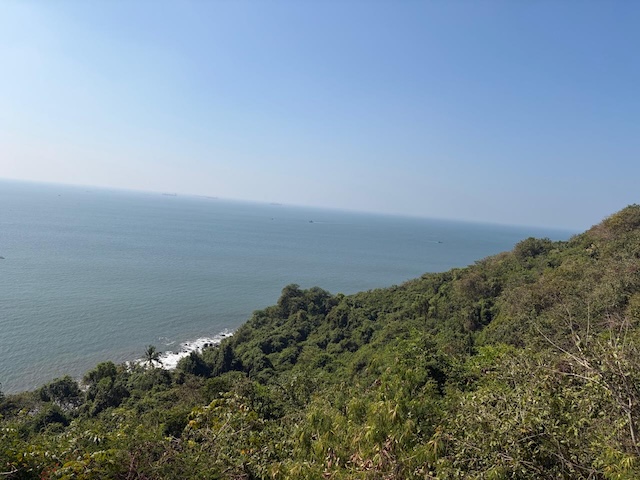
The fort is actually in ruins. But the place offers stunning vistas of river, sea and the inlands beneath. About the fort- it is a 18th century fort built by Goa’s viceroy to protect the place from Marathas and Bhosales of Sawantwadi. Later it became a garrison.
Near the Chapora fort is the Vagator beach with its red laterite cliffs. Vagator beach is known for its cliff-top views and photography . A very dramatic beach due to the presence of the cliffs, it shows a different view of Goa.
Anjuna Beach
Anjuna Beach is one of Goa’s most iconic and historic beaches, especially known for its hippie legacy and flea market culture.It was once the heart of Goa’s 1960s–70s hippie movement. It is not a long, continuous beach and is broken into small coves.
The Anjuna flea market, happening every Wednesday hosts vendors from Kashmir to Tibet. It starts from afternoon and goes well till the evening. Water sports like snorkelling can also be done here. This is one of the must see’s at Goa.
Calangute Beach
This is one of the most visited beaches in Goa. It is often called the “Queen of Beaches” in Goa.It has a long, wide stretch of sand, great for walking. Hub of water sports too- parasailing, water skiing ,surfing etc. Apart from this there is a 18th century Calangute church which has its bearings in the 16th century.
Baga Beach:
This is an extension of Calangute with prominent night life- dance, music ,lively bands etc. Ingo’s night market happens here.
Candolim Beach & Sinquerim Beach
Candolim beach is less crowed and commercialised compared to Calangute & Baga. Sinquerim happens to be an extension of this beach. This is where you can indulge in few water sports in North Goa like parasailing, jet ski etc. You can also choose to do dolphin spotting near the Agoda fort.
This beach is frequently visited due to the presence of the Agoda fort nearby. This fort was built by Portuguese in 1612 to protect Goa from Dutch. The upper part of the fort lies atop Sinquerium Plateau. The fort wall running through offers a panarmoic view of Panjim and Mandovi river. A 1864 light house exists nearby which requires permission to enter.
The fort is specimen of Portuguese Architecture. It has still standing large stone walls and ramparts; canons and defensive bastions. Some fort parts were used as Aguada Jail in colonial times.Huge water storage tanks inside the fort that held millions of gallons — part of why ships used this port.The lower part of the fort is in Candolim beach.
Around Candolim you also have Coco beach and Nerul. Then there is Reis Magos. Reis Magos also known as the Church of Three Kings is a beautiful church with the background of cliffs and the blue sea beyond. There is a restored fort here of Adil Shah times and it is known as Reis Lagos fort. This served as the second line of defence-the first was Aguada fort.
Miramar beach:
This is Panjim’s very own beach. The Mandovi river joins this sea. You can go for a swim here as there are lifeguards here. National Institute of Watersports is located here. Icecreams, vada-pav, cut raw mangoes, cucumbers are all the rage here. So indulge in it quite freely. Near by is also Cabo chapel-A 1541 structure and also Dona Paula beach.
South Goa beaches:
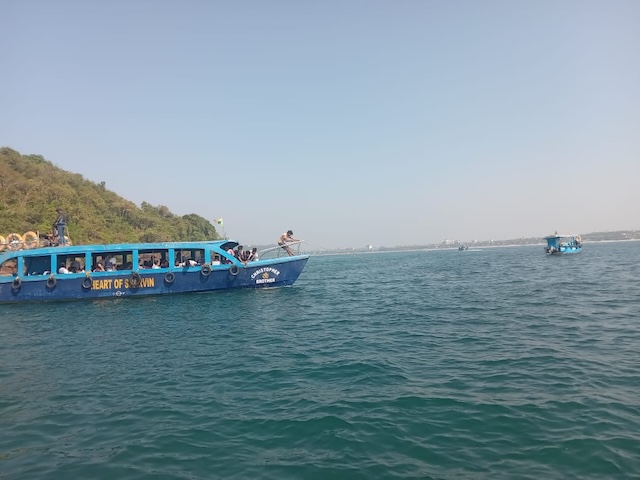
South Goa beaches are equally fascinating as North Goa ones. The stretch of 26km of South Goa boasts of beaches from Bogmalo to Agonda. Take a look.
Bogmalo beach:
This beach is quite close to Dabolim airport of Goa. And what makes its interesting apart from it being relatively quiter is that two islands Issorcim and San Jacinto can be accessed from here. Diving is also done from here.
Velsao beach
Velsao Beach is one of those beaches where Goa feels unhurried and intimate.A long, wide stretch of soft sand, backed by coconut palms. It is quite, village like. There are rice fields near the beach.Walk, swim ,visit the Velsao chapel; nearby are Arossim and Majorda beaches where you can try out Cansaulim Church,indulge in water sports and check out the Mae de Deus church near Majorda. Utorda and Betalbatim beaches are also close by.
Colva beach
Colva is approachable South Goa—open, friendly, and balanced.It offers boat trips to spot dolphins, crocodiles, water sports- jet skiing to parasailing ,Colva church and Sernabatim beach nearby . The Benaulim beach is also a great beach nearby and has a Baptist church . The place is famous for crafts – altars and images of saints.
Other places to check out from here are
Mobor Beach is South Goa at its most polished, spacious, and quiet.Uniquely placed between the Arabian Sea and the Sal River, giving it a calm, island-like feel.
Varca Beach is calm, comfortable South Goa—perfect if you want the sea without distractions and a stay that feels restful rather than eventful.
Palolem beach:
This used to be a quiet beach; but no longer. There are quite a lot to do here from exploring rock called the Pandavas drum, coves ,dolphin spotting etc. Around Palolem are the Rajbaga beach, Patnem and Gajljibaga beach and Agonda. Do not forget to check out the Cabo de Rama fort. It is one among the oldest forts in Goa.It is named after Lord Rama.
It was occupied by the Portuguese, who built military structures and a small chapel.And used by the British before being abandoned.
Leave a Reply