
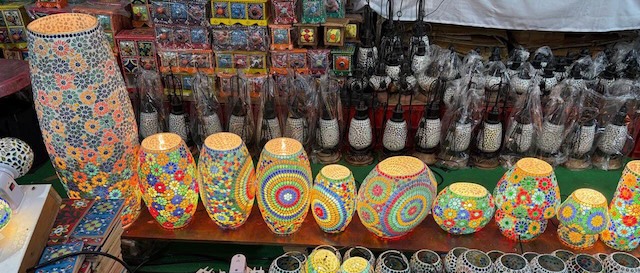
Often, we move from stall to stall at exhibitions, hunting for a good deal, a pretty piece for the house, or something special to gift. But rarely do we pause to look beyond the borders of the stall—into the deeper history of the object in our hands.
This was the lesson I learnt last weekend, while wandering through a ceramic exhibition at Karnataka Chitrakala Parishad.
It was weekend exhibition and I went there simply to pass time. With stalls of Pattachitra, Kashmir shawls, Rajasthani snacks and Madhubani painting vying for my attention, my eyes simply skipped over the ceramic stall. It was the usual pots, lights, tea cups, plates and jars. And so my eyes simply ran over them. But then a small tile caught my eye. Entirely blue, it featured a white elephant—a tiny yet striking piece of art. Looked perfect for gifting and the price was just right. So I took few pieces and came back home.
On closer inspection I noticed the delicate floral patterns on the tiles—they seemed to whisper a story of their own. And it was then I realised that these were Jaipur ceramics with a legacy of their own. Discover more about this in this post.
Quartz Pottery at its best
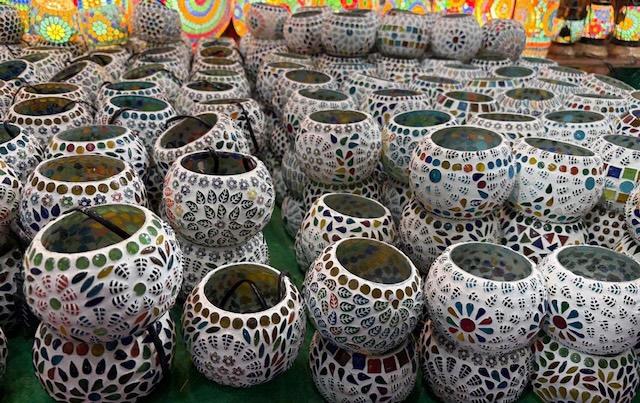
These pots are not clay!Unlike your usual earthenware or porcelain these do not use clay. These are the famous Jaipur ceramics or also known as blue pottery. And guess what they are made from? A mix of powdered quartz, glass, Fuller’s earth (Multani mitti), borax, and gum.
The inspiration is Persian Art for this. Not just the process of making them but also the use of floral motifs, birds & animals in blue and white is a style of Persian art. The Mughal period saw this style penetrating into the country. And made its home in Jaipur. The fact that quartz the raw material is readily available in places like Ajmer, Udaipur etc helps.
The local artisans added regional elements into it like the motifs, elephants, peacocks, and vibrant colors, giving it a distinct identity.
Over time, Jaipur became the center of Blue Pottery in India, blending Persian technique with local culture.
Jaipur Ceramics and Rajput Support
When Persian and Mughal artisans introduced the craft, it was the Rajput rulers of Jaipur who provided royal patronage.Around the late 1600s, Jaipur was ruled by Raja Ram Singh I
He invited skilled artisans from Persia and Delhi to teach the craft to local potters.While Persian pottery focused on floral, geometric designs, the Rajputs encouraged Rajasthani motifs. Hence you see the elephants, peacocks, lotuses, and desert-inspired patterns the Jaipur ceramics.
By the 19th century, Jaipur Blue Pottery had declined, but the Maharajas revived it. Maharaja Sawai Ram Singh II and Maharaja Sawai Madho Singh II (r. 1880–1922) revived it. They imported artisans from Delhi and Persian-influenced workshops to train locals and also promoted the craft in palaces, public exhibitions, and as gifts, ensuring visibility and prestige.
Jaipur School of Art also played a role by formalizing techniques and training artisans. It was founded in 1866 to train local artisans and students. Initially it focused on miniature painting, decorative arts, , but later included ceramics, block printing, and other crafts.
Jaipur Ceramic Process
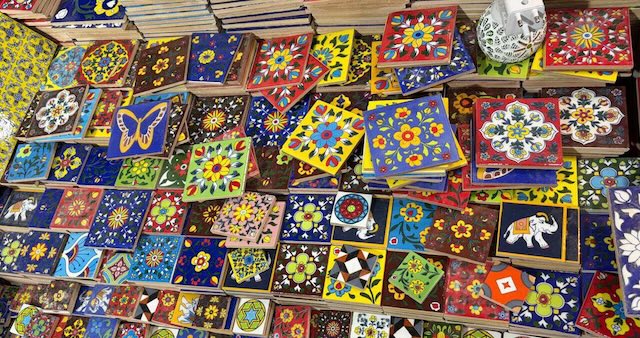
Jaipur ceramics is also called blue pottery, because blue dominates the surface design. Cobalt oxide is used to create the deep, vibrant blue seen on tiles. While blue is primary, Jaipur ceramics may also include green, yellow, and brown.However, the craft is instantly recognized for its blue-and-white contrast.
The process of making Jaipur ceramics has its roots in Persia. The technique of glazed, low-fired pottery with cobalt blue designs originated in Persia.
First the dough is prepared mixing all the ingredients like quartz, glass etc; allowed to dry and then rolled out in to a flat piece. The mould is prepared from POP. And the flattened dough is set on the mould and left to dry for 1-2 days.
The product is smoothened with a sandpaper and later once again smoothened to start painting the product. An outline is prepared and painted ;later colours, chiefly oxides are used. Green is derived from the copper oxide and white. The product is then glazed and fired in a kiln.
Changing With Times
By mid-1900s, the craft had again declined due to changing tastes.
Kripal Singh Shekhawat, a legendary artist and teacher, revived Jaipur Blue Pottery in the 1960s–70s. He trained a new generation of artisans, reintroduced traditional cobalt blue designs and floral patterns and expanded production to include modern home décor items while retaining traditional techniques.
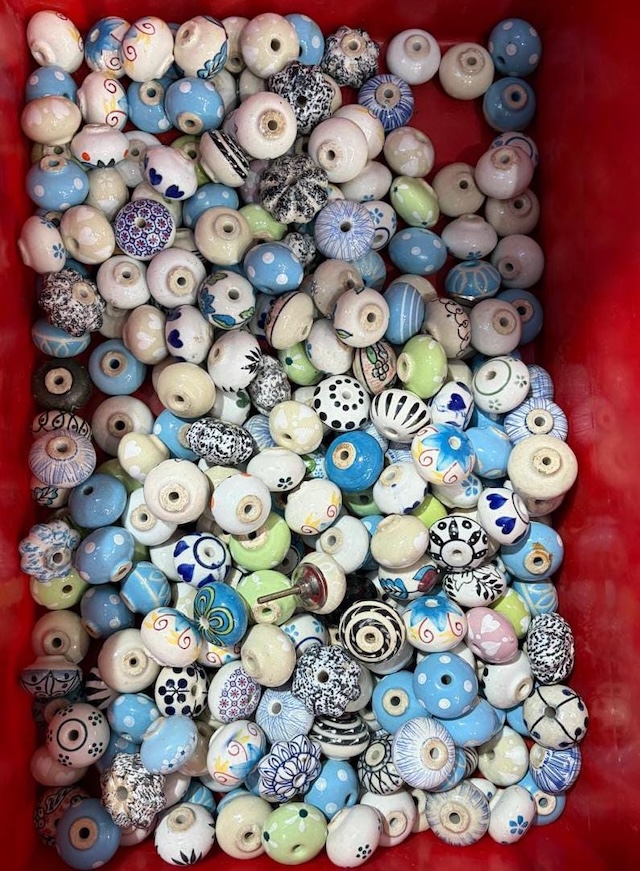
This is what you often see in exhibitions today, making Jaipur ceramics a lucrative choice for buyers. From coasters and wall hangings to lamps, showpieces, and more, these pieces have become a trendy and appealing option for urban customers.



Leave a Reply