
What do you usually do when you are angry?
Get mad. Even. Break things? Shout? Curse everyone? Blame yourself?
Or go for walk?Hike? Do boxing? Or Tai Chi!
Whichever option you choose, make sure you are doing the choosing. And you are the boss of the moment.
You should not be doing things in auto pilot or simply reacting. That’s a waste of time. Because once the action is done without forethought you will think, overthink; things will repeat in your mind endlessly. And you will waste time either worrying, regretting or getting more angry.
When you do not think through your actions , there is always guilt, anger and despair not satisfaction.
Only when you pause, think and choose you do the right thing.
Let us take an example.
Consider your friend called you a bad name.
What do you do?
You get angry. You get defensive. How dare he calls me that?Who does he think he is? Is he crazy or what? … Thoughts multiply and you react!
You will break things, shout or say something bad about you. And you walk away perhaps.
But coming back home you may still be angry, depressed, worried….Because when you are not aware of what your actions there is always regret at the end.
So as adults or even as teens we can understand this. We can take deep breaths , step back, pause and then act.
But what about children?
Teach them. Teach them techniques- deep breathing, walking, drinking water and so on.
One fun way to teach kids about anger management is through the activity called the chatter box.
When I was young I used to play this game. We used it to call the chatter box – kumkum da batlu. In kannada it meant that it was a container to hold vermillion and other stuff like turmeric. It had four hollows you see and so was an ideal container to hold things.
This is how you make and play the game of chatter box.
Making the chatterbox game
Step 1: Make the Chatterbox
- Take a square sheet of paper.
- Fold all four corners into the center.
- Turn it over.
- Fold all four corners into the center again.
- Fold in half both ways to create creases.
- Slip your thumbs and index fingers into the four pockets.

Step 2: Write Content
For an anger-management chatterbox:
Outside flaps
- Colors: Red, Blue, Green, Yellow
Inside flaps
- Numbers: 1–8
Hidden sections
Write anger-management actions such as:
- Take 5 deep breaths.
- Count backwards from 10.
- Drink a glass of water.
- Walk away for 2 minutes.
- Talk to a trusted adult.
- Draw your feelings.
- Stretch your arms and shoulders.
- Think of one good thing.
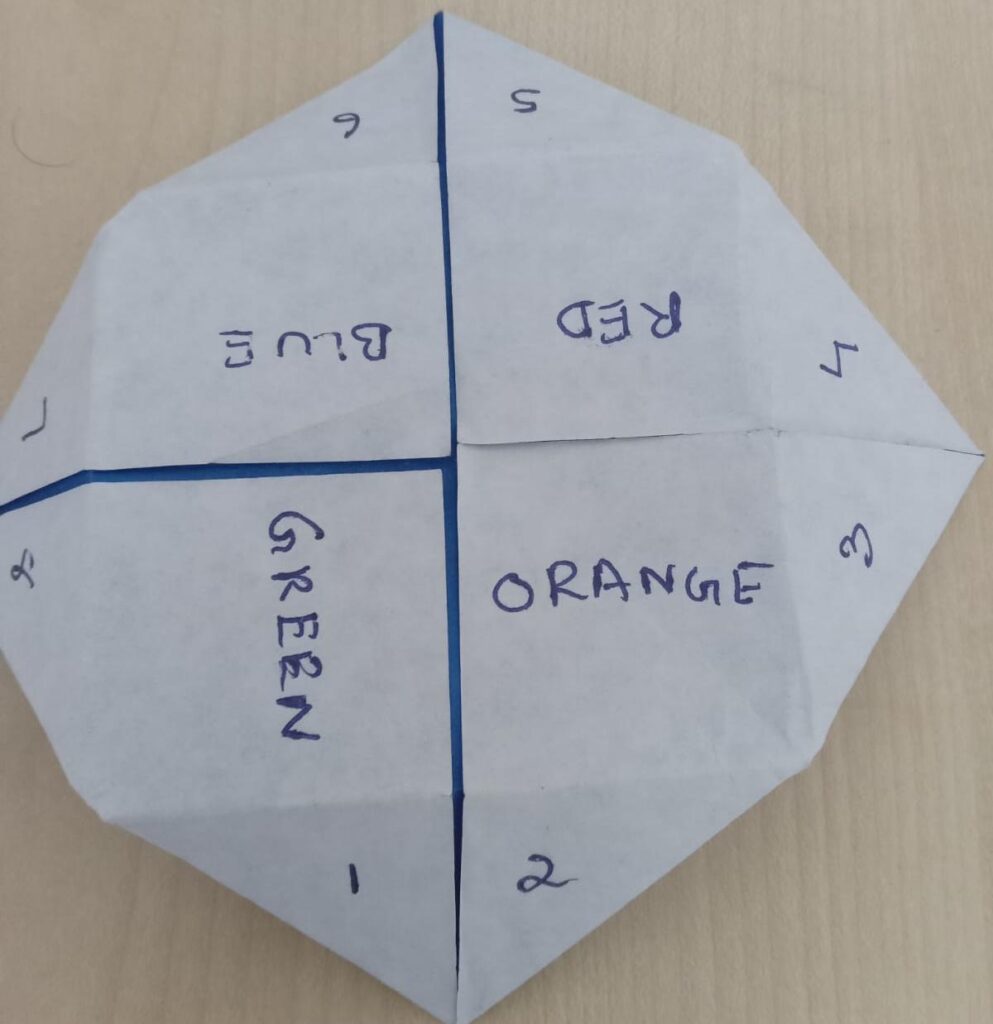
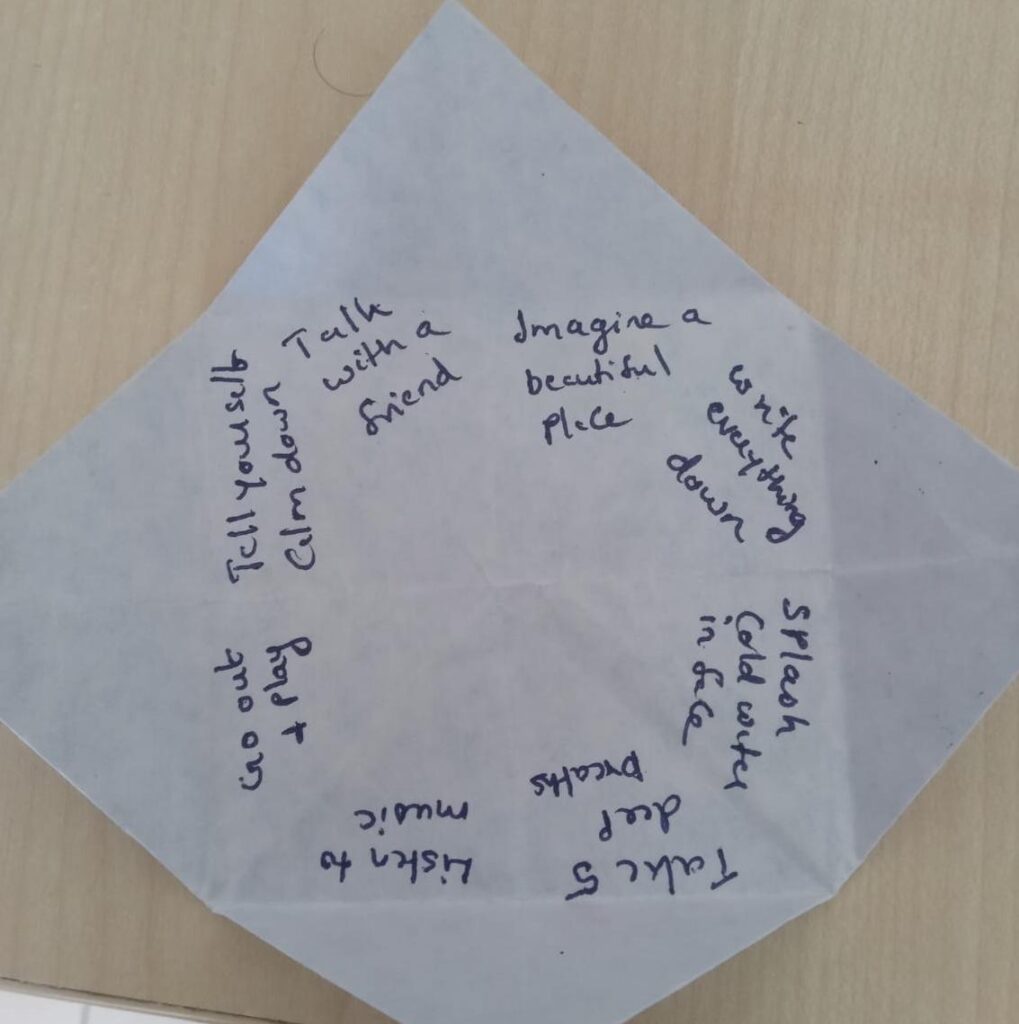
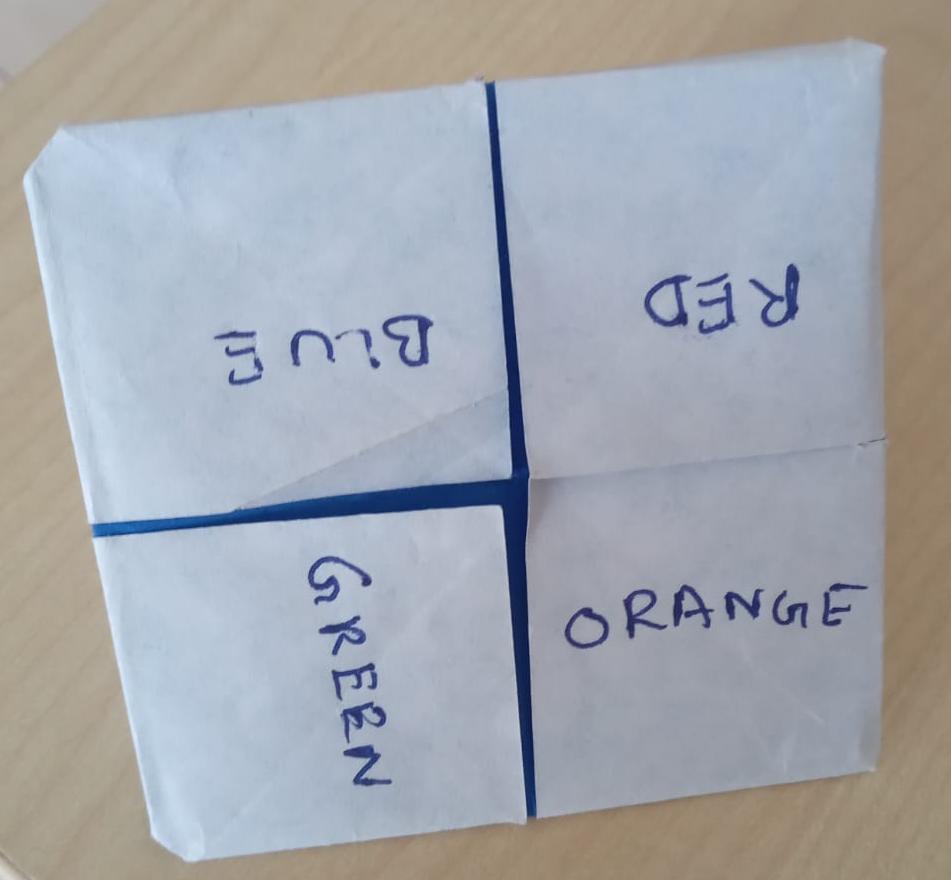
Step 3: Play
Parent/Facilitator: “Choose a color.”
Child: “Red.”
Open and close the chatterbox while spelling:
R-E-D
Facilitator: “Choose a number.”
Child: “5.”
Open and close five times.
Facilitator: “Choose another number.”
Child: “2.”
Open the flap marked 2.
Inside might say:
“Take five deep breaths before you speak.”
A video of chatterbox
Here is a short video demonstration of chatter box game especially tailored for anger management.
Activity in Action:
I recently tried this activity with two young women with intellectual disabilities. This is how it went.
When these women came in to our Mental Health stall , they were full of giggles and smiles. Seeing their happy faces I too broke in to a smile.
Then I asked them, ” Do you get angry a lot?
One of them looked at me and replied,” Yes”
Would you like to become less angry? More cool? I asked.
She said yes.
“Okay then this chatter box is going to help you today. It is going to give you one solution to make you less angry.”
And then we played the game. She felt great delight in choosing numbers. And when she choose one , I asked her to open the flap and see what help the chatterbox had suggested. She got the answer “Take a walk”
And with great flair and drama I told her that this game has given her a magical solution. And she must try this when she gets angry next. Her happy smile was the only answer that she gave me.
Why the game will work in dealing with anger management
I think the chatterbox idea has potential because it combines three things that are known to help learning:
- Play (the game)
- Choice (the child feels they are discovering the strategy)
- Repetition (they encounter anger-management techniques multiple times)
Making The Game Impactful:
To make this game more impactful you can play it in the following ways.
1. Before & After questions:
Before the activity:
- “What do you usually do when you are angry?”
After one week ask the children
- “Did you try any strategy from the chatterbox?”
- “Which one?”
- “Did it help?”
2. Reflection Questions After the Game
Ask:
- Which anger tip did you get?
- Have you ever tried it?
- Which tip do you think would help you most?
Give situations
Also you can give scenarios before playing the game. This makes the children connect the solutions to their problem. For example you could say, ” Say your friend pushed you” or “Your friend called you a bad name” and so on.
That’s it for today. Tell me as a parent did it work? Which age group did you try it out.