When you hear phrases like A Song of Bitter & Sweet, Lost in an Orange Haze, or An Eclipse of the Senses, you probably think of romance. But surprise, I’m talking about chocolate. Then again, love and chocolate do stir the same emotions, don’t they?
Chocolate has reached art of perfection in hands of artists and connoisseurs. Words like crafting a cacao, state of art fermentation, from bean to bar flow freely and what was once a simple bar of plain chocolate has become something far more complex, just like all simple pleasures in life are turning out to be.
You have 64%,73%,91% chocolate combinations and then you have to choose between dark chocolate, milk chocolate , not to mention dark chocolate & orange peels or dark chocolate with watermelon seeds or dark chocolate with paan!
Crazy, experimental, and high innovation mark the chocolate industry of today. There is high demand and there is rise of new chocopreneurs. Hence you have certification courses in chocolate from chocolate tasters to working with couverture chocolate. There are also interesting enterprises that supply equipment to craft chocolates like entry, professional and commercial kits.
This is what I experienced at the Chocolate craft fair- too much chocolate & sweetness along with an eclectic crowd. So here is a brief snapshot of this world through pictures.
From Pod to Beans
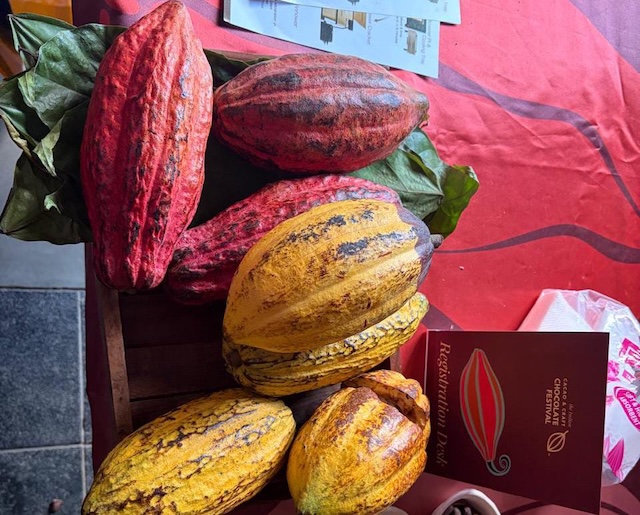
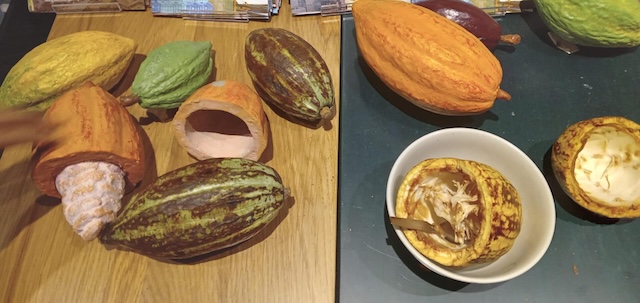
This is the picture of a Cacao pods from where the story starts. These come from the Theobroma cacao tree. The Cacao tree can produce some 20-30 cacao pods at a time. These flower and ripen to a fruit. The cacao pod is a fruit. The fruits are harvested when they turn golden. The pod changes color from red, green, to purple and then yellow.
Inside the pod, there is a sweet pulp with 30–50 seeds. These seeds are what we roast, grind, and turn into chocolate.The seeds are also commonly known as cacao beans.
During the harvest time farmers ensure that the pods are golden yellow and do a tapping test of the pod to ensure that there are seeds inside for picking. The pods are cut manually by using a pruning hook.
Bothe pulp and the seeds are removed and are sent for fermentation. They are then put in wooden boxes, lined with banana leaves and covered with jute bags. Through an anaerobic process the sugars of the pulp get broken down into alcohol, then acetic acid. Note that the sugars for fermentation are coming from the sweet pulp and yeast coming from banana leaves.
A turning of the beans is also done to ensure sufficient oxygen. Beans turn a reddish brown color with a distinct aroma. They are then sent for drying to remove moisture. Here again care has to be taken as drying the beans slowly leads to rotting and drying too quickly means they become acidic. So they need to be raked often. once dried they can be stored.
From Bean to Chocolate
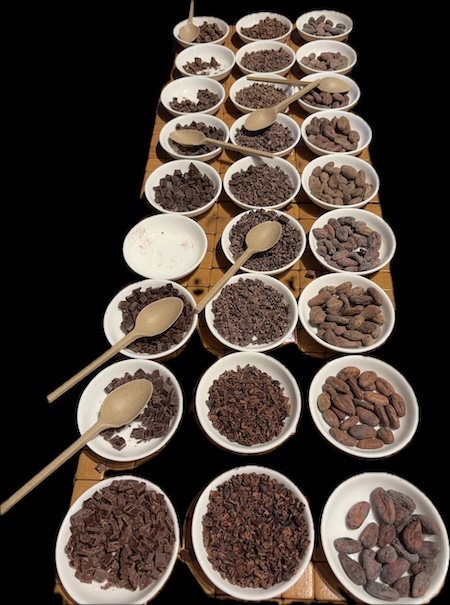
The picture above shows different beans and the resultant hard chocolate. From pod to beans to bar the journey is a long one. The dried beans are then roasted to deepen the flavour. This is when the characteristic chocolate aroma and colour really develop. Roasted beans are cracked open to separate the shell from the nibs.The nibs are the pure chocolate solids. Nibs are ground into a paste called cocoa mass. This is where the Cacao has turned in to cocoa. The cacao becomes cocoa only after fermentation, drying, roasting, and grinding.
This cocoa mass is 100% chocolate. It contains both cocoa solids and cocoa butter naturally. You can add sugar, milk powder and flavours – coffee, orange, vanilla, chilli here. Finally the mixture is cooled and reheated to stabilize the cocoa butter crystals.Flavoured chocolate is poured into molds or used for truffles, bars, or coatings.
Chocolate Technology
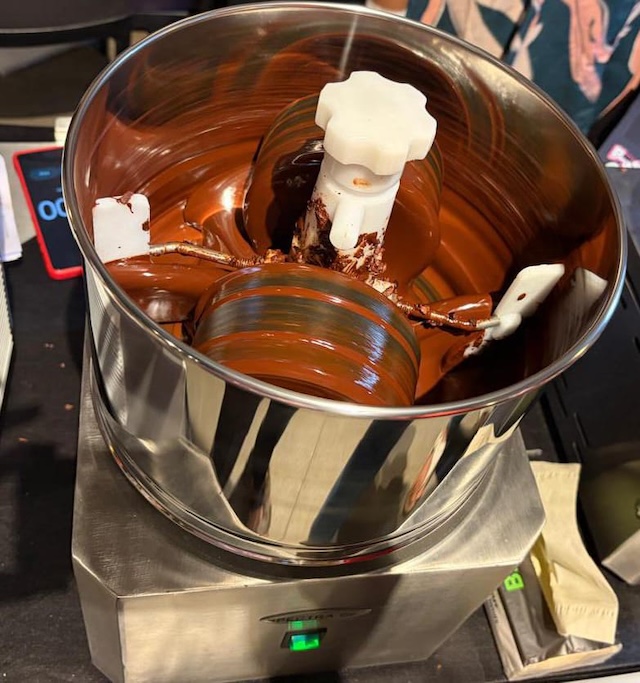
You must have realised that turning cacao beans into the final chocolate involves a sophisticated range of technology, applied masterfully. First, a roaster and temperer are used to roast the beans to perfection. Next, a cracker and basic winnower separate the nibs from the shells.
The nibs are then ground — and ground again — until they form smooth cocoa mass. This mass is heated, mixed, and aerated in a machine called a conche, which develops the chocolate’s flavour and texture. Finally, to produce a bar of chocolate, the mass undergoes tempering and moulding, giving it the signature shine, and smooth finish.