
At the Literary Festival in Bangalore heard an interesting conversation about Krantiveers or revolutionaries that had never reached the limelight. There was Kavita Roa’s book ‘Spies,Lies & Allies’ that talked about two forgotten revolutionaries Virendranath Chattopadhyaya & M.N. Roy. And then there was journalist Jyotsna Mohan who spoke about her grandfather who worked alongside Bhagat Singh and were behind the scene forces.
There were some intriguing questions raised in these discussions. Why did the revolutionaries who fought for the nation’s integrity not receive their fair share of limelight?What if the revolutionaries had joined hands instead of working in isolation? What would happen if the country was freed by the revolutionaries?
Though the authors covered different time periods and the talk was on the forgotten revolutionaries , the real question was this – how much of the information was available in text books ? Are they truly forgotten? Don’t we read them in our schools and colleges? And here is the answer.
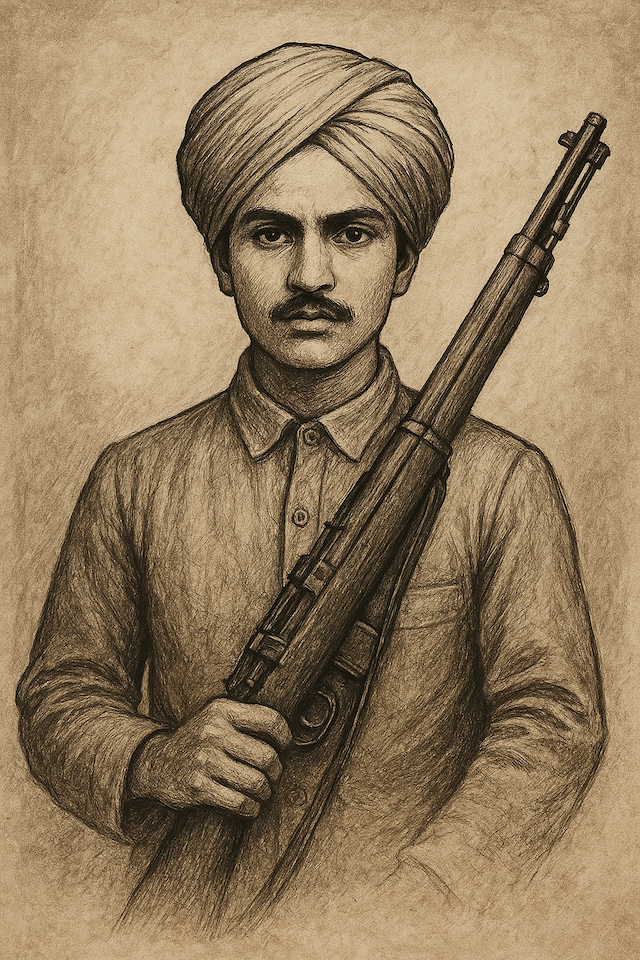
Known as revolutionary nationalists though the British chose the term terrorists for them, they were patriots who believed in freeing the country through forceful means. Their belief was that force should be met with force. Hence the violence. They formed groups, met clandestinely, made bombs, propogated revolutionary ideas through pamphlets,books etc, knew about firearms and weapons and so on.
Their approach was different, radical. And yes, they did not try to generate a mass revolution. And that was their problem.
So who were these revolutionaries? and what did they do? These heroes as I chose to call them in this post are no less than the action heroes of today leading a dangerous life, travelling to places and meeting secretly to carry out their covet operations. Here is a brief list.
Vasudev Balwant Phadke – first person to found a secret society in Maharastra had true action hero traits. He once disguised himself as a wandering ascetic and travelled across regions to secretly build an armed militia—right under the British radar.
The Chapekar brothers carried out one of India’s earliest planned undercover assassinations—tracking British officers for days, studying their routes, disguising themselves, and striking with absolute precision during the 1897 plague-era public event in Pune. The Savarkar brothers(Vinayak Damodar Savarkar and Ganesh Damodar Savarkar) once coordinated a covert network where messages, weapons, and revolutionary plans were passed through students disguised as ordinary travelers—so secretly that even British intelligence later admitted they could not crack the chain for years.
Ras Behari Bose pulled off one of the most daring escapes in Indian revolutionary history—disguising himself as a Japanese tourist, slipping past British surveillance, and vanishing from India entirely while the CID had flooded the country with his portraits.
Secret societies were formed in various places like Nasik, Satara, Gwalior,Baroda, Nagpur etc. Punjab, Banaras, Uttar Pradesh, Delhi- were the hub of these actions. The main centres however were Maharashtra and Bengal.
In Bengal a secret society was formed known as Anushilan Samiti. It was led by Barindra Kumar Ghosh, Bhupendra Nath Dutt and Pulin Behari Das. They published books like Bhavani Mandir and Vartaman Rajniti. The samiti operated like a secret paramilitary academy—running covert gyms that looked like ordinary akharas from the outside, but inside they trained young recruits in hand-to-hand combat, coded messaging, explosives, and undercover movement.
Their members used fake names, shifting safehouses, and silent courier routes so effectively that British intelligence often could not tell who belonged to the group and who didn’t.
And do you want a lone wolf like action hero? Then Madan Lal Dhingra fits the bill. Before assassinating Curzon Wyllie in London, Madan Lal Dhingra practised shooting in absolute secrecy—renting a revolver under a false identity, training alone at odd hours, and memorising escape routes around the Imperial Institute so British detectives would have no chance of predicting his move.
Coming to Jatin Bhaga- the British intelligence mentioned that “Bagha Jatin moved like a shadow—everywhere, yet nowhere.”
He once outwitted an entire British surveillance unit by travelling under multiple disguises—at times as a village doctor, at times as a wandering sadhu—while secretly coordinating the Indo-German conspiracy to land shiploads of arms on India’s coast.
And let us not forget the Kakori case. The Kakori revolutionaries pulled off their train raid with military-grade precision—studying timetables for weeks, mapping the track in darkness, signalling each other with coded lantern flashes, and stopping the train at the exact lonely spot where British patrols never came.
It was one of the most meticulously planned covert operations of the freedom struggle, carried out with the discipline of a guerrilla strike team.
And mission of Bhagat Singh! Saunders, the British officer in Lahore, became the target of a secretive, high-stakes assassination plot by Bhagat Singh and his comrades—who spent weeks tracking his movements, memorising his schedule, and planning the attack with such precision that it read like a covert spy mission in the heart of colonial power.
The Chittagong raid is no less of a military operation. The revolutionaries led by Surya Sen planned the raid like a military operation—scouting British armouries, secretly mapping patrol routes, and moving at night in small, disguised groups to seize weapons. They even set up safe houses and escape routes across Chittagong, turning the city into a covert battlefield against the British.The raid attacked a police armoury! And declared an interim government too!
And Chandrashekar Azad ; he was called as ghost of the revolution. Azad was a master of disguise and escape—he often carried fake identities, changed his appearance on the fly, and moved through crowded cities without leaving a trace, all while secretly coordinating bomb-making and intelligence operations for the Hindustan Socialist Republican Association.
So the revolutionary activities continued even till 1930 and beyond.
Even abroad there were such activities like Home Rule Society in London,Ghadar Party of USA,Indian Nationalist Party by Chempakaraman Pillai. Raja Mahendra Pratap went a step further than most revolutionaries—he boldly proclaimed and established a provisional Free Indian Government in exile.
Subhash Chandra Bose Indian National Army, even the Quit India Movement and 1946 revolt of Indian Navy- all are examples of revolutionary activity.
Some got limelight and shone, while some are only names in history textbooks. But reading their biographies is one way of paying tribute to these patriots. Their life stories are no less colourful than James Band and Mission Impossible movie series.
Here are some books related to their lives. And photographs of these heroes can be looked at here.